Hardware · Navigation and inertial
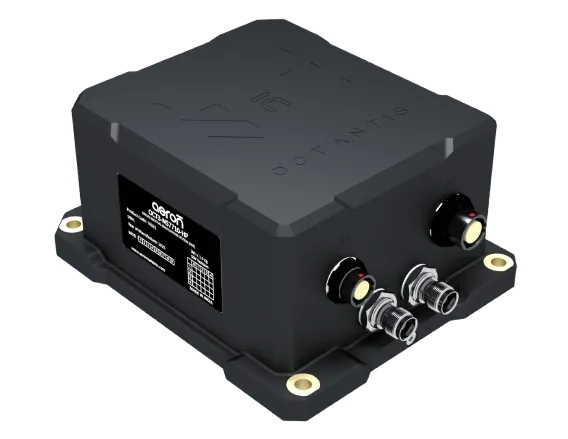
Octantis 3 INS-GNSS
Rugged Dual Antenna Inertial Navigation System for Unmanned and Land Applications
Overview
The Octantis 3, OCT3-NS7700T, is the third generation, high-performance, rugged dual antenna GNSS-aided MEMS-based inertial navigation system. The dual antenna GNSS Compassing configuration ensures accurate heading from the outset, making it an ideal choice for pointing and navigation applications such as armoured vehicles, UGVs and USVs.
Engineered with Aeron's own proven Inertial Measurement Unit — featuring 3-axis low-noise accelerometers and low-drift gyroscopes — the OCT3-NS7700T integrates our proprietary NavPro engine leveraging a multi-modal Kalman filter, powered by a high-speed processor architecture for superior performance in demanding applications.
Qualified to MIL-STD-704F, MIL-STD-1275E, MIL-STD-810H, and MIL-STD-461G standards, the system guarantees reliability in challenging environments. Its multi-frequency (L1/L2/L5, IRNSS/NavIC), multi-constellation GNSS receiver offers high signal sensitivity and is resistant to intentional jamming and spoofing.
Model code: OCT3-NS7700T
Key features
- High Performance Tactical IMU. Octantis features Aeron's own IMU incorporating high-performance MEMS sensors (0.8°/hr gyro BI) offering exceptional GNSS-denied performance.
- Low Drift in No GNSS. Provides accurate heading information in static as well as dynamic conditions, reducing dependency on magnetometer.
- Dual Antenna Multi-Constellation GNSS. Integrated L1, L2 and L5 (GPS, GALILEO, IRNSS/NavIC) GNSS receiver with RTK positioning and compassing capability.
- Rugged MIL Qualified Design. Equipment qualified to MIL-standards for power supply, EMC, and environmental conditions.
- Resistance to Interference. GNSS receiver-level safeguard from intentional jamming and spoofing, providing more resilient positioning.
- Multiple Supported Interfaces. A wide array of interface options and protocols over 2×RS232, 2×RS422, Ethernet, CAN and 1PPS time synchronization.
- Precision Position Performance. RTK-based precision positioning with 0.8 cm accuracy for robotics, autonomous mobility, and precision surveying using unmanned vehicles.
- Accurate Attitude Performance. Provides accurate attitude and heading performance essential for stabilisation applications.
- GNSS Denied Performance. Delivers <1% DT (CEP) performance in GNSS denied conditions with speed aiding.
Applications
- Armoured Vehicle
- Unmanned Ground Vehicle (UGV)