Hardware · Motion sensors
Galileo Digital Magnetic Compass
Compact Digital Magnetic Compass for Heading Determination
Overview
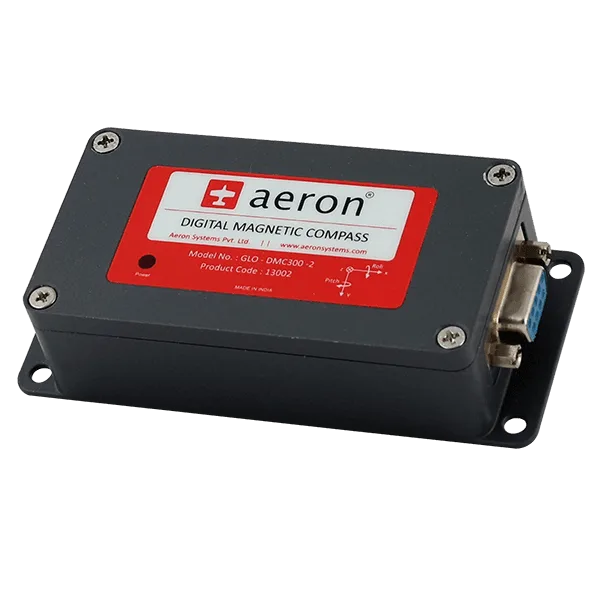
The GALILEO family's GLO-DMC300 is a reliable, low-power and compact digital magnetic compass that measures magnetic heading with high accuracy, suitable for land and marine applications. It comprises a triaxial solid-state MEMS accelerometer and magnetometer, running a proprietary digital filter to deliver stable heading, roll and pitch data even under dynamic conditions.
GLO-DMC300 comprises a triaxial solid-state MEMS accelerometer and magnetometer. The accelerometer measures roll and pitch in static conditions, while the magnetometer estimates heading — the roll and pitch readings are then used to tilt-compensate the heading angle. A proprietary digital filter reduces noise and computes stable heading information even under dynamic conditions.
GLO-DMC300 is a plug-and-play device with configurable update rates and RS232/RS485 interfaces, most suited for compassing, surveying, antenna orientation and other direction-sensing applications across land and marine platforms.
The Galileo GLO-DMC300 is a compact, low-power digital magnetic compass that measures magnetic heading, roll and pitch with a triaxial MEMS accelerometer and magnetometer. Heading is tilt-compensated, with ±1° (1σ) heading and ±0.5° (1σ) roll and pitch accuracy under the conditions given in the datasheet. RS232 or RS485 output suits unmanned vehicle, marine, surveying and antenna orientation applications.
±1° Heading Accuracy · RS232 / RS485 · Hard & Soft Iron Calibration · IP50
Key features
- Triaxial solid-state MEMS accelerometer and magnetometer
- Roll & pitch used for tilt compensation of heading angle
- Proprietary digital filter for noise reduction under dynamic conditions
- Hard iron and soft iron calibration
- Configurable output rate — 1 / 10 / 20 Hz
- Plug-and-play with RS232 or RS485 interfaces
Features
- High Accuracy Compass. Delivers digital compass heading with high resolution and accuracy for demanding navigation tasks.
- Communication. RS232 and RS485 interface options make it easy to integrate with an external controller.
- Tilt Compensation. Tilt-compensated heading output accounts for low-dynamics roll and pitch movement.
- User Calibration. On-site hard iron and soft iron calibration via the desktop software utility improves accuracy.
- Low Power Consumption. Draws less than 150 mA at 12 V, suited for integration into battery-powered equipment.
- Low-Noise MEMS Sensors. Built around low-noise triaxial accelerometer and magnetometer sensors for stable output.
Applications
- Unmanned Vehicle Navigation
- Robot Navigation
- Marine Navigation
- Antenna Orientation
- Surveying